
IronDiff vs RANCID — Replace Perl Scripts with Zero-Maintenance Config Backups
If you’ve been running RANCID for years, you probably know the drill: it works until it doesn’t, and when it breaks, you’re debugging Expect scripts and .cloginrc entries at 2 AM. IronDiff was built to replace that entire workflow with a lightweight Docker or Windows agent.
No credit card required. Deploy in under 5 minutes.
What is RANCID?
RANCID (Really Awful Nasty Cisco config Differ) is the original open-source network configuration backup tool, first released in the early 2000s. It connects to network devices via Expect scripts, pulls running configurations, and stores them in CVS or SVN for version control. For over two decades it’s been the default answer to “how do I back up my Cisco configs.”
But RANCID was designed for a different era. Its architecture assumes you’re comfortable maintaining Perl dependencies, writing Expect login scripts, configuring CVS repositories, and reading diffs from the command line. If that describes your team, RANCID still works. For everyone else, the maintenance overhead has become the problem.
Where RANCID Falls Short
- Fragile Expect scripts — device interaction is handled by Expect, which breaks when firmware updates change prompts, banners, or timing. Every break requires manual script debugging.
- Perl dependency chain — RANCID depends on Perl modules that need to be installed and maintained on the host. Version conflicts and missing dependencies are a recurring headache.
- CVS/SVN version control — most teams have moved to Git. RANCID still defaults to CVS, and while SVN support exists, neither is where the industry is headed.
- No web interface — viewing diffs means using
cvs diffon the command line or setting up a third-party frontend like ViewVC. There’s no built-in way to share changes with your team. - No secret handling — passwords, SNMP community strings, and pre-shared keys are stored in plain text in your version control system.
- Manual
.cloginrcmanagement — every device’s credentials are maintained in a flat file. No encryption, no central management, no audit trail. - Minimal activity — RANCID’s development has slowed significantly. Community support is sparse and bug fixes are infrequent.
How IronDiff Compares to RANCID
| Feature | IronDiff | RANCID |
|---|---|---|
| Deployment | ✅ Docker or Windows agent | ⚠️ Perl + Expect + CVS/SVN + cron |
| Visual Diff Dashboard | ✅ Red/green cloud portal | ❌ CLI diffs or ViewVC |
| Automatic Secret Redaction | ✅ Vendor-aware engine | ❌ Plain-text storage |
| Encryption at Rest | ✅ Post-quantum zero-knowledge | ❌ None |
| Device Credentials | ✅ Encrypted in Docker agent | ⚠️ Plain-text .cloginrc file |
| Auto-Updates | ✅ Built-in via Watchtower | ❌ Manual |
| Inbound Firewall Rules | ✅ Zero required | ⚠️ Depends on setup |
| Web UI | ✅ Full cloud portal | ❌ None built-in |
| SAML SSO | ✅ Azure AD, Okta, Google | ❌ No |
| Multi-Vendor Support | ✅ Cisco, Aruba, pfSense, Fortigate, MikroTik, Juniper, Netgear | ✅ ~50 vendors |
| Version Control | Cloud-hosted with full history | CVS or SVN |
| Cost | Free tier available, paid plans | Free (open-source) |
| Actively Maintained | ✅ Yes | ⚠️ Minimal activity |
See the Difference
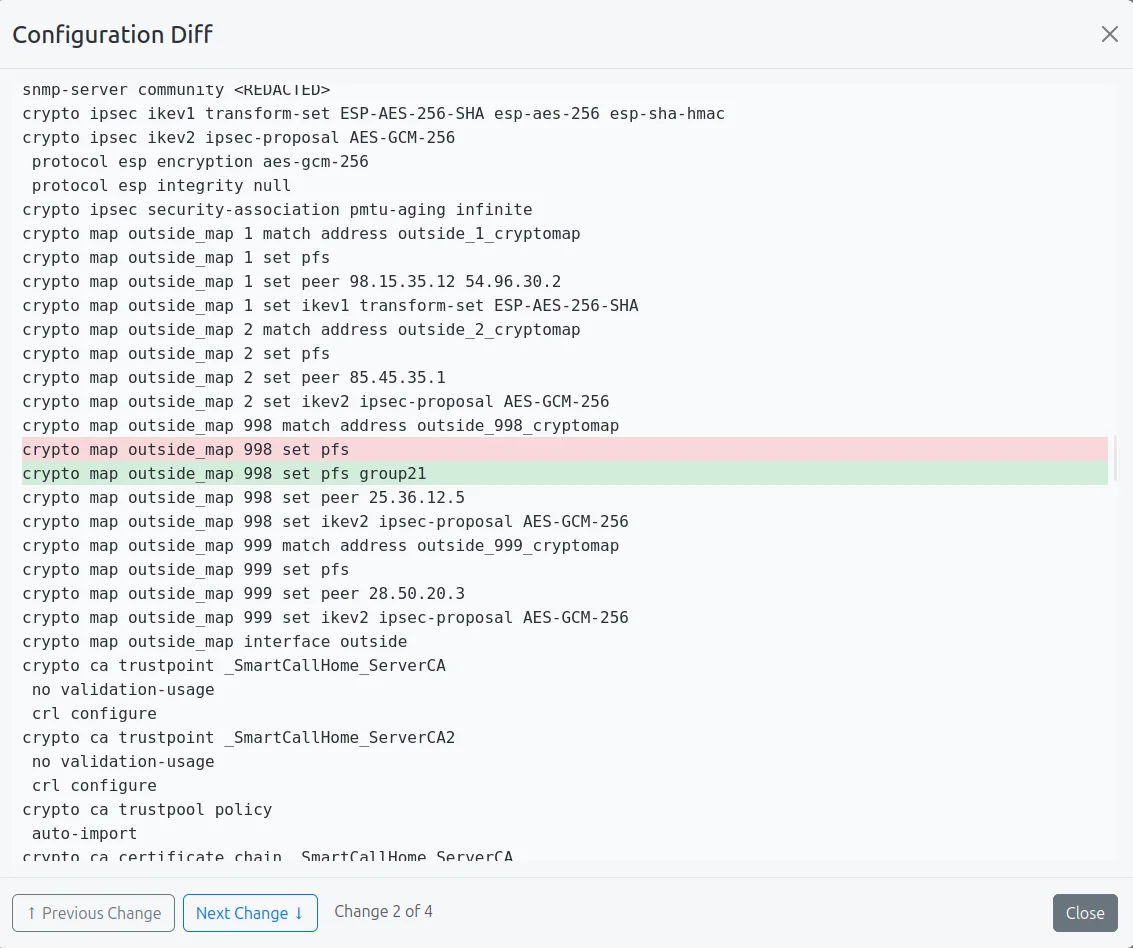
Here’s what config drift looks like in IronDiff — a clean visual diff instead of a cvs diff dump:
Done wrestling with Expect scripts?
Deploy the IronDiff Docker agent in 5 minutes. No Perl required.
Who’s Using IronDiff
IronDiff is built by an MSP for MSPs. It’s currently managing config backups across production networks for managed service providers who got tired of maintaining RANCID and Oxidized instances alongside their actual client work.
Ready to Retire RANCID?
Start with our free tier — no credit card, no Perl, no CVS.
Get Started For Free or View Pricing